In the quest for advanced thermal insulation materials, scientists have turned to nature for inspiration, leading to the development of ice-templated ceramics. These innovative materials mimic the intricate porous structures found in biological systems, offering unparalleled efficiency in heat resistance. The unique architecture of ice-templated ceramics not only provides exceptional thermal insulation but also maintains structural integrity under extreme conditions, making them a promising solution for industries ranging from aerospace to construction.
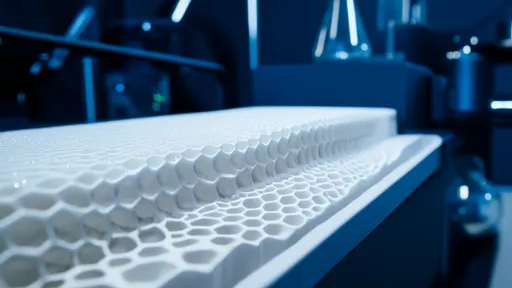
The process of creating ice-templated ceramics begins with the controlled freezing of ceramic suspensions. As ice crystals form, they push ceramic particles into the interstitial spaces, creating a scaffold-like structure. Once the ice is removed through sublimation, what remains is a highly porous ceramic framework that mirrors the delicate, yet robust, designs seen in natural materials like bone or wood. This biomimetic approach results in a material that is both lightweight and strong, with thermal conductivity values that rival or surpass those of traditional insulation materials.
What sets ice-templated ceramics apart is their ability to precisely control pore size and distribution. By adjusting freezing parameters such as temperature gradient and cooling rate, researchers can tailor the material's microstructure to specific applications. For instance, smaller, more uniformly distributed pores enhance thermal insulation by minimizing heat transfer through conduction and convection, while larger, interconnected pores may be desirable for applications requiring gas permeability or fluid transport.
The thermal performance of these ceramics is nothing short of remarkable. Laboratory tests have demonstrated that ice-templated ceramics can achieve thermal conductivity as low as 0.015 W/mK at room temperature, outperforming many conventional insulation materials. This exceptional property stems from the material's ability to trap air within its nano-sized pores, effectively creating a barrier against heat transfer. Moreover, the ceramic matrix itself contributes to the insulation properties, as ceramics are inherently poor conductors of heat.
Beyond their impressive thermal properties, ice-templated ceramics exhibit excellent mechanical stability. Unlike traditional porous materials that often sacrifice strength for insulation capacity, these biomimetic structures maintain considerable compressive strength despite their high porosity. This combination of properties makes them particularly attractive for applications where both thermal protection and structural support are required, such as in building envelopes or spacecraft thermal protection systems.
The environmental benefits of ice-templated ceramics further enhance their appeal. The manufacturing process is relatively energy-efficient compared to traditional ceramic production methods, and the materials used are often abundant and non-toxic. Additionally, the porous structure can be designed to be open or closed, allowing for potential applications in filtration or as catalyst supports, thereby expanding their utility beyond thermal insulation.
Current research is focused on scaling up production and exploring composite versions of ice-templated ceramics. Scientists are experimenting with incorporating nanomaterials or phase-change materials to create multifunctional insulation systems. These advanced composites could potentially store thermal energy while providing insulation, opening up new possibilities for energy-efficient building materials and thermal management in electronic devices.
As industries worldwide strive to meet increasingly stringent energy efficiency standards, ice-templated ceramics emerge as a versatile and sustainable solution. Their biomimetic design not only offers superior thermal performance but also aligns with the growing demand for environmentally conscious materials. With ongoing advancements in processing techniques and material combinations, these nature-inspired ceramics are poised to revolutionize thermal insulation across multiple sectors.
The development of ice-templated ceramics represents a perfect marriage between materials science and biomimicry. By learning from nature's time-tested designs, researchers have created a new class of materials that address some of the most pressing challenges in thermal management. As this technology continues to mature, we can expect to see ice-templated ceramics playing an increasingly important role in our built environment and industrial applications, paving the way for more energy-efficient and sustainable technologies.

By /Jul 18, 2025

By /Jul 18, 2025

By /Jul 18, 2025

By /Jul 18, 2025
By /Jul 18, 2025
By /Jul 18, 2025

By /Jul 18, 2025
By /Jul 18, 2025
By /Jul 18, 2025

By /Jul 18, 2025

By /Jul 18, 2025

By /Jul 18, 2025

By /Jul 18, 2025
By /Jul 18, 2025

By /Jul 18, 2025

By /Jul 18, 2025
By /Jul 18, 2025

By /Jul 18, 2025

By /Jul 18, 2025

By /Jul 18, 2025