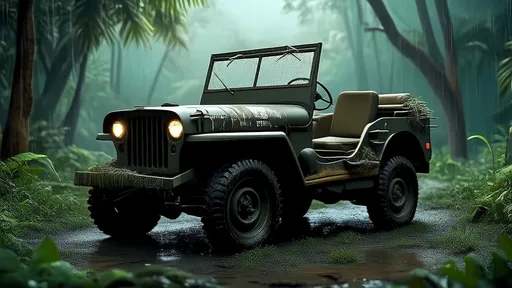
The automotive industry has long been focused on improving vehicle aesthetics and maintenance, but recent advancements in real-time dirt generation algorithms are taking this pursuit to an entirely new level. These sophisticated algorithms, powered by machine learning and computer vision, are capable of simulating and predicting how dirt, grime, and environmental debris accumulate on a vehicle's surface in real-time. This technology is not just a novelty—it has far-reaching implications for car manufacturers, autonomous vehicle developers, and even gaming industries.
How Real-Time Dirt Generation Works
At its core, real-time dirt generation relies on a combination of environmental data, vehicle dynamics, and material science. Sensors placed on the vehicle collect information about weather conditions, road surfaces, and driving speed. This data is then fed into an algorithm that calculates how particles interact with the car's surface. The algorithm considers factors like aerodynamics, surface texture, and even the chemical composition of the dirt. The result is a dynamic, ever-changing representation of dirt accumulation that mirrors real-world conditions with startling accuracy.
One of the most challenging aspects of this technology is simulating the way different materials interact with dirt. For example, a matte finish will accumulate grime differently than a glossy one. The algorithm must account for these variations, adjusting its calculations to reflect the unique properties of each surface. This level of detail requires immense computational power, but recent breakthroughs in edge computing have made it feasible to run these simulations in real-time.
Applications Beyond Aesthetics
While the immediate application of this technology might seem superficial—helping car washes or detailing services predict when a vehicle needs cleaning—its potential uses are far more profound. Autonomous vehicle developers are particularly interested in how dirt accumulation affects sensor performance. Lidar, cameras, and other sensors can be obstructed or impaired by dirt, leading to potential safety hazards. By predicting where and how dirt will accumulate, these systems can proactively schedule maintenance or adjust sensor sensitivity to compensate.
In the gaming and simulation industries, real-time dirt generation adds an unprecedented layer of realism. Racing games, for instance, can now show vehicles getting progressively dirtier as they navigate different terrains and weather conditions. This not only enhances visual fidelity but also impacts gameplay, as accumulated dirt might affect vehicle performance or visibility. Film studios are also adopting this technology to create more realistic CGI vehicles, reducing the need for manual texturing and post-processing.
The Future of Real-Time Dirt Simulation
As the technology matures, we can expect to see even more innovative applications. Some researchers are exploring how real-time dirt generation could be used in predictive maintenance. By analyzing patterns of dirt accumulation, the system might detect early signs of wear and tear or even identify potential mechanical issues before they become serious. For example, uneven dirt patterns could indicate alignment problems or aerodynamic inefficiencies.
Another exciting frontier is the integration of this technology with augmented reality (AR). Imagine pointing your smartphone at a car and seeing a real-time simulation of how it would look after a week of commuting in rainy weather. This could revolutionize the car buying process, allowing customers to visualize how different paint colors and finishes will weather over time.
Despite its promise, real-time dirt generation is not without challenges. The computational demands are significant, and achieving truly accurate simulations requires vast amounts of data about environmental conditions and material properties. There are also questions about privacy, as the systems that collect environmental data could potentially be used to track vehicle movements or driving habits.
Nevertheless, as processing power continues to increase and algorithms become more refined, real-time dirt generation is poised to become a standard feature in multiple industries. What began as a way to make virtual cars look more realistic may end up changing how we design, maintain, and interact with vehicles in the physical world. The humble speck of dirt, it turns out, has much to teach us about technology, design, and the complex interplay between vehicles and their environments.
By /Aug 15, 2025

By /Aug 15, 2025

By /Aug 15, 2025

By /Aug 15, 2025

By /Aug 15, 2025
By /Aug 15, 2025
By /Aug 15, 2025
By /Aug 15, 2025
By /Aug 15, 2025

By /Aug 15, 2025
By /Aug 15, 2025

By /Aug 15, 2025

By /Aug 15, 2025

By /Aug 15, 2025

By /Aug 15, 2025

By /Aug 15, 2025
By /Aug 15, 2025

By /Aug 15, 2025

By /Aug 15, 2025

By /Aug 15, 2025